




KONTAN.CO.ID - In recent years, digital transformation in Indonesia has accelerated significantly. Especially during the pandemic, when all business sectors were forced to adapt to sudden changes, including banking. Banking industry players are competing to provide banking services accessible solely through apps, from creating accounts and paying various bills, saving, and investing, everything can be done from the palm of your hand, without the need to visit a bank branch.
Not only are many banks emerging with new digital services, but many conventional banks are also adopting digitalization or offering digital financial services. Chief Executive of Banking Supervision at the Financial Services Authority (OJK), Dian Ediana Rae, stated that many conventional banks are finally starting to seriously consider providing digital services, as digital services allow banks to automate many banking transaction processes, thereby streamlining operational costs.
Furthermore, digital services also enable industry players to expand their reach. As long as the infrastructure in a region or area is adequate, and people have smartphones and internet connections, they can be reached and potentially become customers.
According to Bank Indonesia data, as of September 2024, the number of bank transactions using digital services reached 1,929.33 million, representing a 40.45% annual growth compared to 1,373.63 million transactions in the same period the previous year. Meanwhile, transaction value also increased by 54.89% to a total of Rp7,492.93 trillion in September 2024, up from Rp4,837.57 trillion in the same period in 2023.
This growth is driven by the large Gen Z population, the largest generation currently in Indonesia. This generation, who has grown up with technological advancements, plays a crucial role in shaping digital economic trends. Based on Populix’s research, ‘Studi Analisis Ekosistem dan Persepsi terhadap Bank Digital di Indonesia’ (in translation: ‘Ecosystem Analysis and Perception Study of Digital Banks in Indonesia’), reveals several factors considered important by the public when using digital services.
The research was conducted online with 250 male and female respondents, with 60 percent Gen Z and 40 percent millennials, aged 17-39, located in the Greater Jakarta area, Java, Sumatra, and several other cities.
According to the research, some of the key factors considered important by respondents when using digital services include data and transaction security (31%), flexibility in accessing the application (12%), comprehensive application features (12%), integration with other financial services (11%), and special promotions (10%). People are becoming accustomed to conducting banking transactions through banks with digital services. Research also shows that respondents living in the Greater Jakarta area tend to use two to three banking applications with digital services to meet their daily needs.
According to the research, based on usage, VP of Research at Populix, Indah Tanip, revealed that banks with digital services are primarily used for e-wallet top-ups (54%), interbank transfers (49%), e-commerce shopping (48%), and inter-account transfers (47%).
This demonstrates that every bank with digital services is required to at least be able to meet these standard needs through their applications. Certainly, banks with digital services that can offer a variety of financial services that exceed customer needs will be able to become leading players in this industry.
Currently, with the emergence of many banks with digital services, competition in this industry is increasingly fierce. Players in this industry are competing to attract potential customers and retain existing ones to use their services. Each bank with digital services is implementing various strategies to expand their reach, such as offering competitive interest rates.
Banks with digital services offer above-average interest rates to raise funds. However, ultimately banks with digital services that can offer a variety of services to meet the banking transaction needs of all customer segments will become the public’s primary choice. Bank Neo Commerce (BNC), one of the earliest banks with digital services, is now able to meet the financial transaction needs of various customer segments, from individuals, MSMEs, and corporations. Currently, BNC, through its neobank application, is one of the most comprehensive banking applications.
President Director PT Bank Neo Commerce Tbk, Eri Budiono said, “BNC offers a variety of financial services for all our customers. We see that the public appreciates the services BNC provides, including NOW savings products, WOW deposits, QRIS payment services, transfer via Virtual Account (VA), PPOB transactions, and the Neo Loan product, which serves customers who need loans for various purposes.”
For MSME customers, BNC offers the Neo Business service, which allows MSMEs to manage their financial and business transactions, and also allows them to separate personal and business finances. For corporations, BNC has had a Corporate Internet Banking (CIB) service since 2023. The CIB service allows corporate customers to easily and conveniently conduct transactions for business purposes.
In addition, BNC also introduced the BNC Payroll product for corporate customers in early 2023, which makes it easier for companies to pay employee salaries from one account to multiple accounts in a single transaction.
The comprehensive range of banking and products that BNC provides, must of course be supported by reliable information technology to ensure customer transaction convenience.
“From the beginning of our transformation into a bank with digital services, the information technology sector has been one of our primary concerns. We understand that digital banking must guarantee data security and provide a seamless transaction experience. Furthermore, as Bank Neo Commerce now serves tens of millions of customers using a variety of banking services across various customer sectors, ensuring our customers feel comfortable using the services we provide is crucial,” explained Eri.
Future Projections for Banks with Digital Services
The future of banks with digital services is expected to continue to improve. This will occur in line with the increasing adoption of technology and shifts in customers' behavior regarding their banking transactions. Recent technological developments, such as Artificial Intelligence (AI), are also enabling various new innovations in the banking world, enabling banks with digital services to offer more personalized financial services to customers, making these services more effective and efficient.
Eri added, “Given the rapid increase in the use of digital banking services in 2024, we see a very promising future for digital banking, driven in part by favorable demographics. Survey data shows that Gen Z is currently the largest generation in Indonesia. They are a generation that grew up with technology, so they are more familiar with it and its developments.”
BNC continues to focus on providing financial services that meet evolving needs of customers from all segments.
“In 2025, Bank Neo Commerce will focus on boosting assets in commercial banking. Furthermore, we will continue to encourage increased use of direct loans through neobank apps so that they can be used by more customers to meet various needs,” said Eri.
Article sources: https://pressrelease.kontan.co.id/news/tren-perkembangan-bank-dengan-layanan-digital-di-indonesia




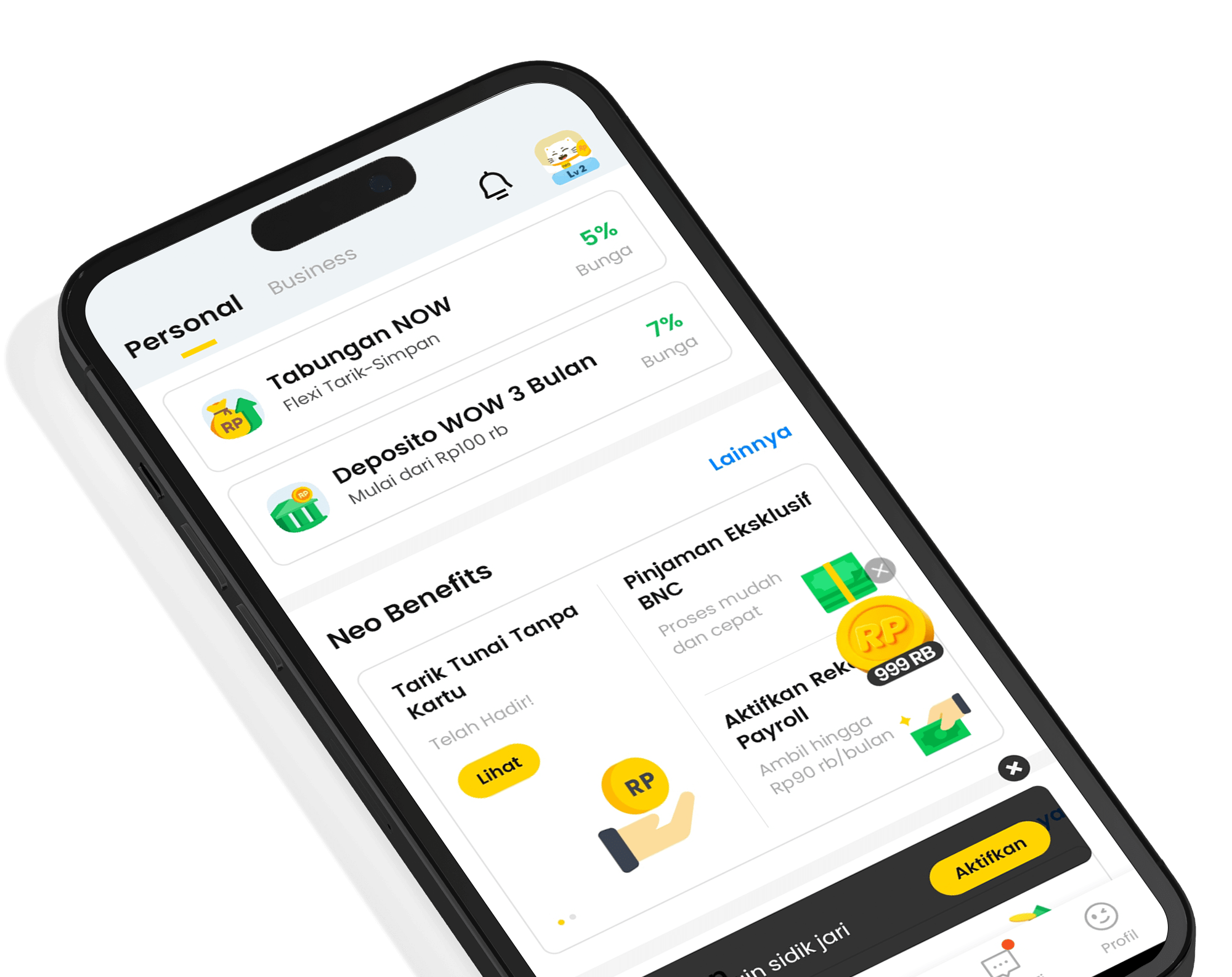
What are you waiting for?
Let's try neobank now!
.png)
.png)

PT Bank Neo Commerce Tbk is licensed and supervised by the Financial Services Authority (OJK) & Bank Indonesia (BI) and is a member of Indonesia Deposit Insurance Corporation (LPS).
The maximum deposit amount insured by LPS per customer per bank is Rp2 billion. To find out the LPS Guaranteed Interest Rate, please access here.
Copyright © 2023, All Rights Reserved, PT. Bank Neo Commerce Tbk


PT Bank Neo Commerce Tbk is licensed and supervised by the Financial Services Authority (OJK) & Bank Indonesia (BI) and is a member of Indonesia Deposit Insurance Corporation (LPS).
The maximum deposit amount insured by LPS per customer per bank is Rp2 billion. To find out the LPS Guaranteed Interest Rate, please access here.


Copyright © 2023, All Rights Reserved, PT. Bank Neo Commerce Tbk